Openers · Mississauga
Garage Door Opener Diagnosis and Repair
The motor runs, the chain rattles along the rail, and the door does not move a millimetre. You notice the little carriage sliding back and forth on its own.
Garage Door Opener Diagnosis and Repair
In plain words
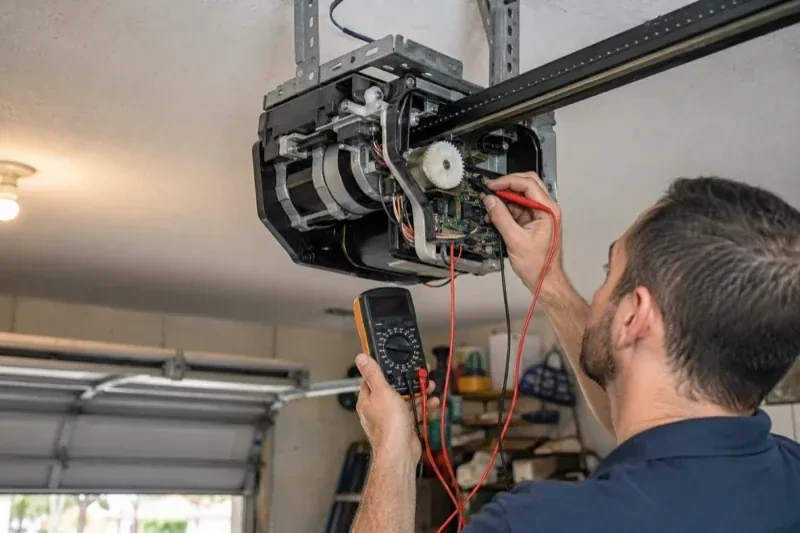
Garage door opener diagnosis is a fault-finding visit with a fixed order of tests. The technician confirms power at the ceiling receptacle, tries each control on its own, checks the safety sensors and their indicator lights, examines the drive train from motor to trolley, and reads any flash code the unit is showing. Only then is a part named, because a dozen different faults look identical from the driveway and guessing at the part costs you a second visit. When the cause is a small component, the repair is made while the technician is there; when it is not, you get a clear account of what comes next.
How the visit goesIt is a January morning and the door lifts about a hand's width, groans, and settles back down. When you pull the release and try by hand the door feels far heavier than it used to, and the bottom seal is stuck hard to the slab.
Mississauga
How the visit goes
The story before the tools
Diagnosis begins with what you saw and heard. When did the door last behave, and what changed between then and now: a power outage, a storm, a new light bulb, a shovel leaning against the sensor, someone pulling the red cord? Does the motor hum, click, run or stay silent? Does the fault follow one control or all of them? Is the door stranded up or stranded down, and does it move at all by hand? A few minutes of this on the phone or at the door points the technician at one part of the system instead of all of it, and often shortens the visit considerably.
Door first, opener second
When the by-hand check shows the door is heavy, drifting or binding, the work order changes. The opener is left disconnected and the door side is corrected first: worn rollers replaced, dry hinges and rollers lubricated, loose track brackets tightened, a dropped header bracket re-secured, and spring or cable faults handed to the tensioned-hardware work they require. Only when the door lifts and holds by hand is the trolley re-engaged and the opener tested again. Very often the opener that seemed faulty runs perfectly once it is moving a balanced door, and the repair becomes lighter and longer-lived than any change made at the motor.
Ready for the cold months
After a winter diagnosis the door is set up for the season rather than for the day. The bottom seal has been freed and, if it was tearing, replaced, with a light silicone wipe so it releases from the slab. Moving parts carry a low-temperature lubricant. The photo eyes have been cleaned and, where low sun was blinding one, shaded or swapped side to side. Force has been set for a cold, stiff door without being pushed up to hide one. Keep snow and ice cleared from the threshold and the sensor lenses, and expect the door to be a shade slower on the coldest mornings.
Garage Door Opener Diagnosis and Repair
In the van
- Photo-eye sensor pair
- Logic board or receiver
- Drive gear and sprocket kit
- Start capacitor
- Garage door lubricant
What affects the quote
Same fees day, night or weekend
1Sensor realignment versus replacement
Straightening a bracket and cleaning a lens is a small task. Replacing the sensor pair and running new wire along the wall and ceiling is a larger one, and the quote names which applies.
2Whether the door needs work first
If the by-hand check shows a heavy or binding door, the balance, rollers or springs are corrected before the opener is judged, and that door-side work is quoted as its own item.
3Getting in when the door is stuck shut
A garage with no side door and no house connection means working the release from outside before any test can begin, and the quote includes that entry step.
Garage Door Opener Diagnosis and Repair: questions
How do you tell whether it is the opener or the door?
By separating them. With the door closed, the emergency release is pulled so the opener is out of the picture, and the door is lifted by hand. A balanced door rises without strain, hangs where you leave it around waist height and stays open at the top. If it does, the opener is at fault. If it is heavy, drifts or binds, the door is the cause and the opener was only reporting the strain. This one check prevents a great many wrong repairs.
The motor hums but the door stays put. What is usually wrong?
A hum with no movement means the motor is receiving power but something is stopping it turning, or stopping its turn from reaching the door. On AC units a failed start capacitor is the common cause; on chain-drive heads a stripped nylon drive gear is the other. Less often the trolley has simply been released from the carriage. Each of these is a routine repair once identified, and the hum is one of the more helpful sounds an opener makes.
My opener went completely dead after a power outage. Is it finished?
Not usually. Outages and the surges that ride along with them commonly trip a breaker or a ground-fault receptacle, blow the small fuse on the board, or knock out the transformer, and each of those is a modest repair. A surge that damages the logic board itself is the more serious case, and whether that board is replaced or the unit retired depends on the model's age and part availability. The diagnosis tells you which case you have.
Openers & Access
- Belt-Drive Opener RepairPress the remote and the motor runs its full cycle, lights on, the usual whir, but the door does…
- Garage Door Opener ReplacementDuring the ice storm the power was off for two days.
- Photo-Eye Sensor Alignment or ReplacementAfter a cold night the door stays open until the garage warms up.
Garage Door Opener Diagnosis and Repair near you
A door in Mississauga that is lifting unevenly, dropping too far, screeching on the rails or refusing the remote is telling you which part is tired. Our services are grouped around those parts, springs and cables, tracks and rollers, openers and controls, so the fix is easy to identify.